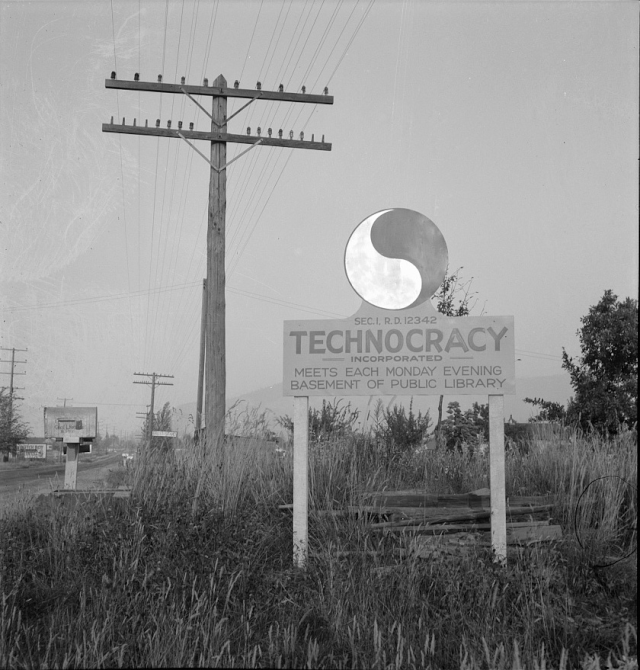
In 1930’s America the ideas presented by the technocrats were preposterous. The necessary “all-pervasive” surveillance system was a technological impossibility.
Technocracy is such a broad concept that it can be used to decribe many different types of hypothetical and very real governments. Listed below are the definitions I believe are important for distinguishing what technocracy is compared to other forms of government. From that point you can understand the pros and cons of technocracy.
To put in perspective, control of government or administration of the United States is given to representatives of the public. These representatives are then tasked with creating laws, policies, and organizations that protect and serve the common welfare of the public. The United States is described as a democracy.
There are no examples of technocracies in the world. However, the group Technocracy Inc. did present a blueprint of a technocratic society. They called it the “Technate Design”. This was published in the Technocracy Study Course, a publication of Technocracy Inc. in 1933.
From the publication Technocracy Inc. outlined the administration of the Technate would be scientific and technical. The main point of emphasis is that problems in society are technical in nature and that they should be resolved by those most skilled and knowledgable in the application of technology. This is as simple as saying doctors would be in charge of making medical decisions, engineers would make engineering decisions, etc without the restrictions or guidance of corporate policies or the Price System. Today, you can say that the power of technology is held by Corporate interest. In a Technate, the responsibility and power of technology would be meritocratic – according to the administration set-up they proposed. The main difference between the Corporate control versus the Technate meritocracy of technology is that one has a vested interest in maximising profit while the other is interested in its functional application. This is why technocrats describe Technocracy as “a government of function” or “the administration of science to the social order”.
The natural questions people would have at this point are “what about the money?”, “who get’s paid?”, etc. It is extremely important to understand this point. Technocracy does not employ a Price System. This is why any comparisons to communism, capitalism, socialism, etc. are not appropriate because it does not employ a Price System. The Technocracy Study Course gives specific reasons why a Price System should not be used and supplies scientific evidence in support of this position. As a summary, the Price System does not allow sufficient administration of technology to solve social problems such as managing the distribution of resources and increasing the standard of living that is sustainable. For the Price System to operate requires the exponential growth of resource consumption especially in the context of energy. Anyone who understands physics, biology, and or ecology should point out that the exponential growth of energy consumption is not sustainable. Any organisms that do this inevitably destroy their resource base and die as a result.
 Prepper1cense